
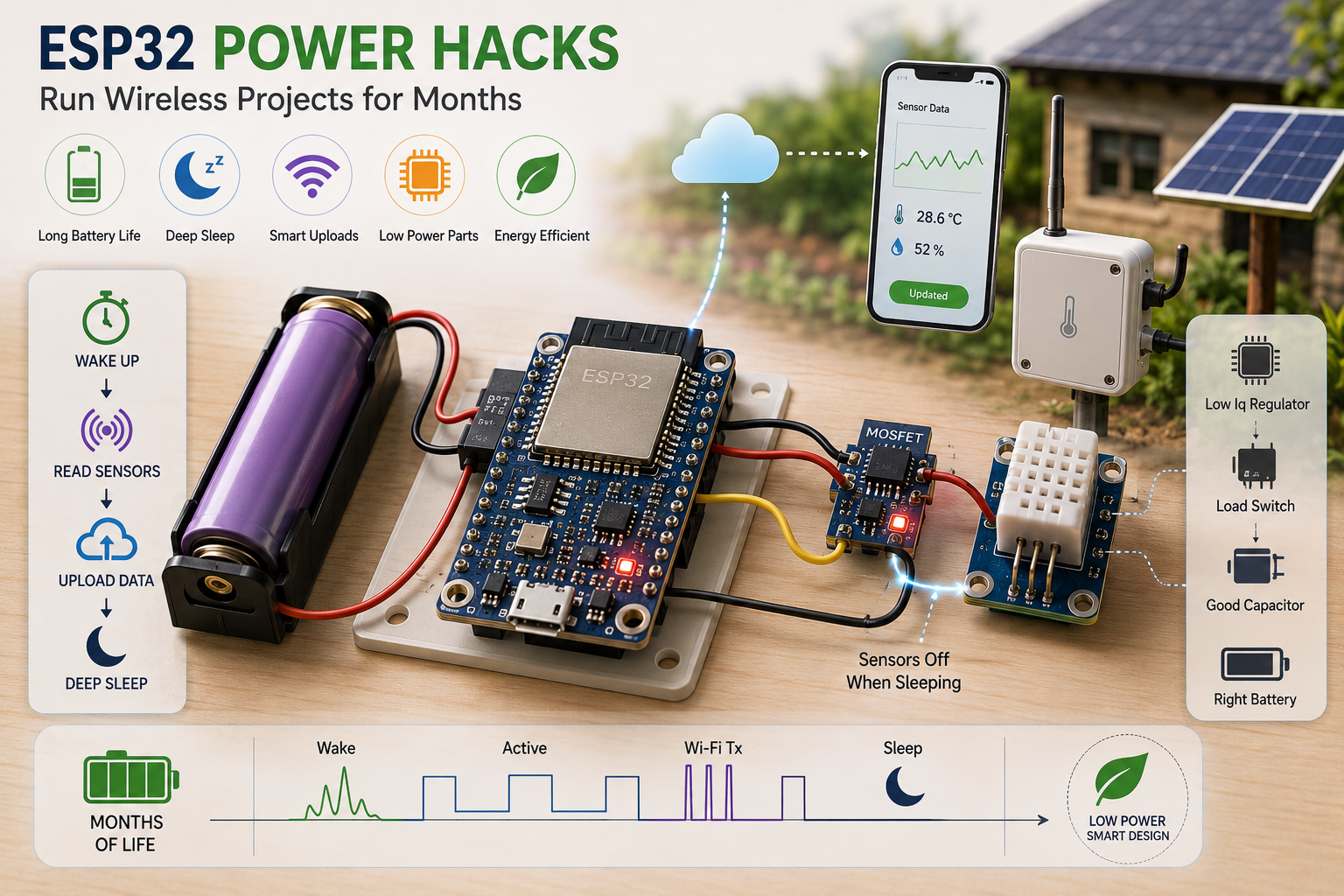
The ESP32 has become one of the most popular microcontrollers for IoT development thanks to its built-in Wi-Fi, Bluetooth, and impressive processing power. However, many makers quickly discover one major challenge—battery life.
A project that works perfectly on a USB cable may drain its battery in just a few hours when deployed in the real world. The good news is that this isn’t a limitation of the ESP32 itself. In most cases, poor power management, inefficient firmware, or unsuitable hardware choices are responsible for excessive energy consumption.
By combining smart firmware techniques with thoughtful hardware design, it’s possible to build wireless sensors and remote monitoring devices that operate for months—or even longer—on a single battery.

Why Most Battery-Powered ESP32 Projects Fail
Many first-time IoT projects focus on functionality before efficiency. The ESP32 remains fully awake, repeatedly scans for Wi-Fi networks, samples sensors continuously, and transmits data more often than necessary. Every unnecessary operation increases power consumption and shortens battery life.
Instead of treating power optimization as a final step, successful designs consider energy usage from the beginning. Every decision—from selecting a voltage regulator to scheduling network activity—affects how long the device can operate between battery changes or recharging.
Understand Where the Power Goes
Before reducing consumption, it’s important to identify the biggest energy users.
The ESP32 itself is only one part of the system. Sensors, LEDs, voltage regulators, communication modules, and even status indicators all contribute to the overall power budget.
The biggest power consumers are usually:
- Wi-Fi transmissions
- Bluetooth communication
- Active CPU time
- High-power sensors
- Always-on LEDs
- Inefficient voltage regulators
Measuring current consumption during different operating modes helps identify where optimization will have the greatest impact.
Deep Sleep Is Your Greatest Battery Saver
For many IoT devices, useful work occupies only a few seconds each hour. The rest of the time, the microcontroller simply waits.
Deep Sleep solves this problem by shutting down most of the ESP32 while preserving only the circuits needed for wake-up events.
A typical workflow looks like this:
Wake Up
   ↓
Read Sensors
   ↓
Process Data
   ↓
Connect to Wi-Fi
   ↓
Upload Data
   ↓
Return to Deep Sleep
This simple cycle dramatically reduces average current consumption because the ESP32 spends most of its life sleeping instead of actively running.
Choosing the Right Wake-Up Strategy
Not every application should wake up the same way. The ESP32 offers several wake-up methods, each suited to different scenarios.
- Timer Wake-Up: Ideal for periodic environmental monitoring or weather stations.
- GPIO Wake-Up: Perfect for button presses, door sensors, or motion detectors.
- Touch Wake-Up: Useful for interactive battery-powered interfaces.
- ULP Coprocessor Wake-Up: Enables basic sensor monitoring while the main processor remains asleep.
Selecting the appropriate wake-up source ensures the device is active only when necessary.
Batch Sensor Data Instead of Sending Everything
Wi-Fi communication is one of the most power-hungry operations on the ESP32. Establishing a connection, authenticating, and transmitting packets consume significantly more energy than reading most sensors.
Instead of transmitting every measurement immediately, collect multiple readings in memory and send them together at scheduled intervals. This approach reduces the number of Wi-Fi connections and extends battery life without sacrificing useful data.
Examples include:
- Sending hourly environmental summaries instead of minute-by-minute updates.
- Uploading vibration data only after detecting abnormal activity.
- Logging measurements locally and synchronizing when the network is available.
Upload Data Only When It Matters
Not every sensor change deserves a network transmission. Many IoT applications can reduce power consumption by sending updates only when meaningful events occur.
Examples include:
- Temperature changes greater than a defined threshold.
- Water tank levels crossing critical limits.
- Motion detection after a period of inactivity.
- Battery voltage falling below a safe level.
Event-driven communication keeps the radio off for longer periods while still delivering timely information.
Choosing Components That Save Power
Firmware optimization alone cannot compensate for inefficient hardware. Every component in the power path affects battery life.
| Component | Better Choice |
|---|---|
| Voltage Regulator | Low-quiescent-current LDO |
| Power Switching | MOSFET load switch |
| Indicator LEDs | Remove or disable |
| Pull-up Resistors | Higher resistance where appropriate |
| Sensors | Low-power or sleep-capable models |
Small improvements across multiple components often produce substantial gains in overall efficiency.
Control Power to External Sensors
Many sensors consume power continuously, even when the ESP32 is asleep.
Using a MOSFET as a load switch allows the microcontroller to disconnect power from sensors that are not needed between measurements.
This simple hardware technique can reduce standby current dramatically, especially in applications with long sleep intervals.
Don’t Forget the Capacitors
Power stability is just as important as low consumption.
During Wi-Fi transmission, the ESP32 can draw brief bursts of current that cause voltage drops if the power supply is poorly designed.
Proper capacitor selection helps maintain stable operation by:
- Supporting current spikes
- Reducing voltage ripple
- Preventing unexpected resets
- Improving radio performance
Using both bulk and ceramic capacitors near the ESP32 ensures a reliable power supply during wireless activity.
Optimize Wi-Fi Connections
Connecting to Wi-Fi repeatedly wastes both time and energy.
Simple firmware improvements can reduce radio-on time:
- Store Wi-Fi credentials efficiently.
- Use static IP addresses when appropriate.
- Minimize reconnection attempts.
- Upload all pending data in a single session.
- Disconnect immediately after transmission.
Reducing connection time often has a greater impact on battery life than lowering CPU frequency.
Measure Before You Optimize
Power optimization should always be guided by real measurements rather than assumptions.
Useful tools include:
- USB power meters
- Digital multimeters
- Oscilloscopes
- Battery analyzers
- Current profiling tools
By measuring active, sleep, and transmission current separately, developers can identify the true sources of power consumption and verify the effectiveness of each optimization.
Common Battery-Life Mistakes
Many ESP32 projects consume more energy than necessary due to avoidable design decisions.
Common mistakes include:
- Leaving Wi-Fi enabled continuously.
- Forgetting to enter Deep Sleep.
- Using inefficient voltage regulators.
- Keeping sensors powered all the time.
- Uploading every sensor reading immediately.
- Ignoring standby current from external components.
- Leaving status LEDs permanently on.
Correcting even a few of these issues can significantly extend battery life.
Who Should Learn ESP32 Power Optimization?
Power optimization is an essential skill for anyone building battery-powered IoT devices. Whether you’re developing smart home sensors, environmental monitoring stations, agricultural systems, wearable electronics, or remote data loggers, understanding how hardware and firmware work together to reduce energy consumption helps create devices that are more reliable, efficient, and practical for real-world deployment.
Conclusion
Maximizing battery life on the ESP32 is not about one magic setting but about combining many small improvements. Deep Sleep, intelligent wake-up strategies, efficient Wi-Fi communication, sensor power control, and carefully selected hardware components all contribute to longer operating times. By designing with power efficiency in mind from the very beginning, developers can build wireless projects that remain responsive while running for months on a single battery, making them better suited for real-world IoT applications where reliability and long-term operation are essential.
Come on, this is hopeless. 90% of the screen is spam!!!!!!!! Impossible to follow and concentrate on the article. Who thought this was a good idea?
What is spamming the article? can you elaborate?