
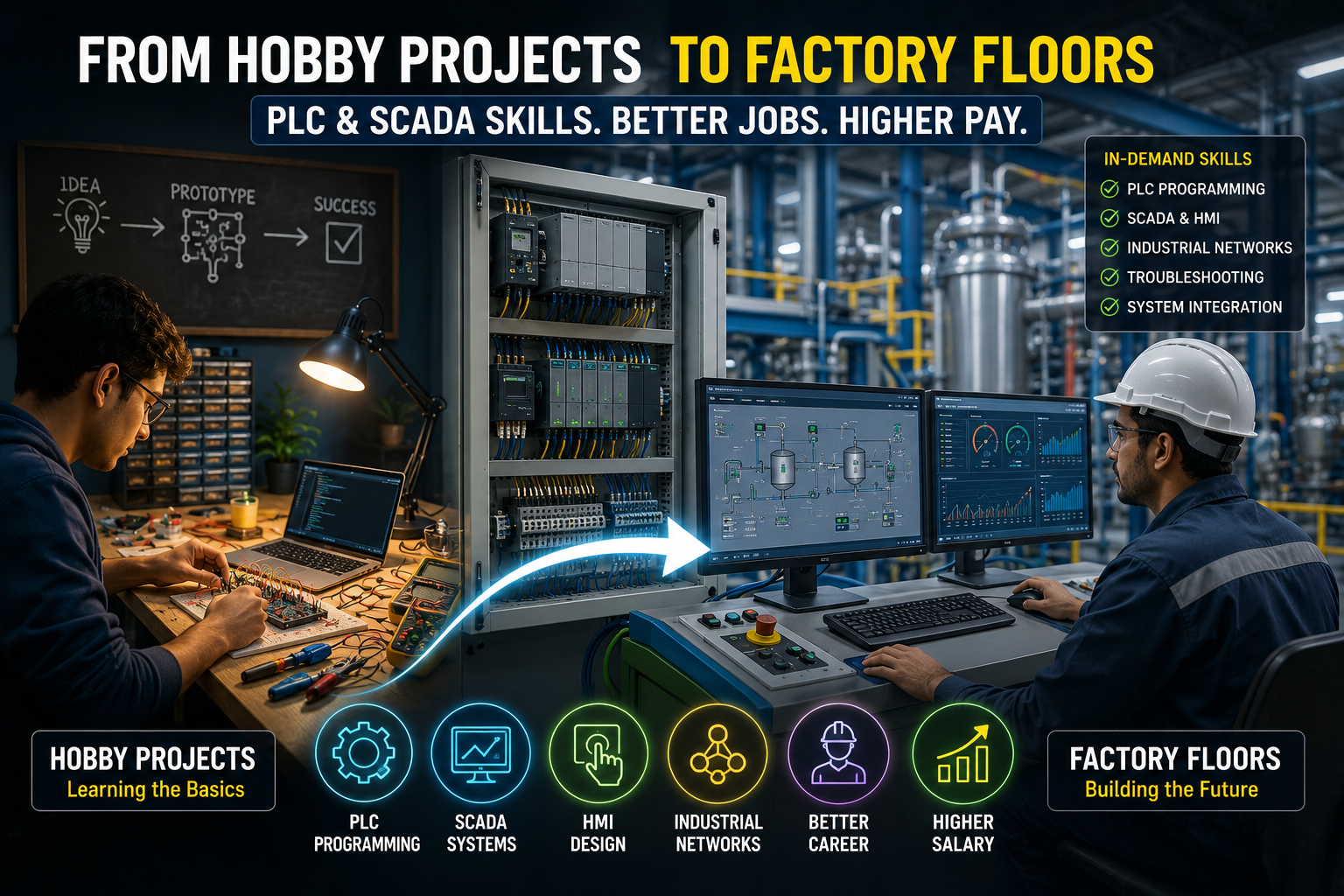
Many electronics enthusiasts begin by programming Arduino boards, building Raspberry Pi projects, or automating simple devices at home. These projects teach valuable programming and hardware skills, but the technologies used in factories are often very different. Industrial environments rely on Programmable Logic Controllers (PLCs), SCADA systems, Human-Machine Interfaces (HMIs), and industrial communication networks to keep production running safely and efficiently.
Learning these technologies bridges the gap between hobby electronics and professional automation. More importantly, it opens the door to careers in manufacturing, energy, food processing, oil and gas, pharmaceuticals, and countless other industries that depend on skilled automation engineers.

Why Industries Depend on PLCs
Unlike hobby microcontrollers, PLCs are designed for continuous operation in demanding environments. They control motors, sensors, conveyors, pumps, robotic systems, and production lines while withstanding heat, vibration, dust, and electrical noise.
Modern factories rely on PLCs because they are reliable, easy to troubleshoot, and built for real-time control. Engineers who understand PLC programming are therefore in demand across a wide range of industrial sectors.
Beyond PLC Programming: Understanding the Complete Automation System
A PLC is only one part of an industrial automation solution. A complete system includes several technologies working together.
SCADA Systems
SCADA (Supervisory Control and Data Acquisition) software allows operators to monitor equipment, collect production data, and control industrial processes from a central location. It provides real-time visibility into factory operations, making it easier to detect faults and improve efficiency.
Human-Machine Interfaces (HMIs)
HMIs provide operators with intuitive touchscreens or control panels to interact with machinery. Well-designed HMIs simplify operation, display alarms, and reduce downtime by presenting critical information clearly.
Industrial Communication Networks
PLCs, HMIs, sensors, and SCADA systems exchange data through industrial communication protocols. Understanding how these devices communicate is essential for building reliable automation systems and troubleshooting network issues.
From Maker Projects to Industrial Automation
Many of the skills developed through Arduino or Raspberry Pi projects translate naturally into industrial automation. Understanding digital inputs and outputs, sensors, relays, motors, and programming logic provides a strong foundation for learning PLCs.
The main difference is scale and reliability. Industrial systems must operate continuously, often around the clock, while meeting strict safety and performance requirements.
How PLC, SCADA, and HMI Work Together
Industrial automation isn’t built around a single device. Instead, several technologies work together to control machines, monitor production, and help operators make informed decisions.
Think of a factory as a team where each technology has a specific responsibility.
| Technology | Main Role |
|---|---|
| PLC | Controls machines and executes automation logic |
| SCADA | Monitors processes and collects production data |
| HMI | Allows operators to interact with machines |
| Industrial Network | Connects controllers, sensors, and devices |
For example, when a sensor detects a full conveyor belt, the PLC immediately stops the motor. At the same time, the HMI displays the machine status while the SCADA system records the event and alerts supervisors if necessary.
Together, these systems create a reliable and efficient production environment.
A Typical Day for an Automation Engineer
Working in industrial automation involves much more than writing PLC code. Every day brings a mix of programming, troubleshooting, testing, and collaboration with production teams.
A typical workday may include:
- Reviewing machine alarms
- Updating PLC programs
- Testing new sensors
- Improving HMI screens
- Monitoring SCADA dashboards
- Troubleshooting communication issues
- Optimizing production efficiency
Some days are spent commissioning entirely new production lines, while others focus on maintaining existing equipment and reducing unexpected downtime. This variety makes automation engineering an engaging career with continuous learning opportunities.
Why Automation Skills Are More Valuable Than Ever
Manufacturing is becoming smarter every year. Companies are investing heavily in digital factories, connected equipment, predictive maintenance, and data-driven production.
As automation expands, businesses need engineers who understand both hardware and software.
Some of today’s biggest industry trends include:
- Smart factories (Industry 4.0)
- Industrial Internet of Things (IIoT)
- Predictive maintenance
- Remote monitoring
- Industrial cybersecurity
- Energy-efficient manufacturing
- AI-assisted process optimization
Learning PLCs and SCADA today prepares engineers for these emerging technologies tomorrow, making automation skills a valuable long-term investment.
Skills That Employers Value
Automation professionals are expected to combine multiple technical skills rather than specialize in a single tool.
Some of the most valuable skills include:
- PLC programming
- Ladder Logic
- Structured Text
- SCADA development
- HMI configuration
- Industrial networking
- Control panel design
- Sensor integration
- Motor control
- Troubleshooting
- Industrial safety
- System commissioning
Developing expertise across these areas makes engineers more versatile and attractive to employers.
Industries That Hire PLC and SCADA Professionals
Automation skills are needed in almost every modern industry.
These include:
- Manufacturing
- Food and beverage processing
- Oil and gas
- Water treatment
- Pharmaceutical production
- Automotive manufacturing
- Logistics and warehousing
- Renewable energy
- Building automation
- Mining
As factories continue adopting smart manufacturing technologies, demand for automation professionals continues to grow.
A Practical Learning Roadmap
A structured approach makes learning industrial automation much easier. Begin by understanding PLC fundamentals and programming logic before progressing to advanced concepts such as data registers and internal relays. Once comfortable with PLC programming, explore SCADA systems to learn how industrial processes are monitored and controlled.
Next, gain experience with HMI development to design operator interfaces that are both functional and user-friendly. Finally, study industrial communication protocols and networking concepts to understand how automation devices exchange information reliably across an industrial environment.
Frequently Asked Questions
Do I need PLC knowledge if I already know Arduino?
Arduino provides an excellent foundation, but PLCs use different programming environments and are designed for industrial reliability.
What is the difference between PLC and SCADA?
A PLC controls machines directly, while SCADA monitors, visualizes, and supervises entire industrial processes.
Are HMIs important?
Yes. HMIs allow operators to interact safely and efficiently with industrial equipment.
Which industries use PLCs the most?
Manufacturing, energy, automotive, food processing, pharmaceuticals, water treatment, and logistics all rely heavily on PLC-based automation.
Can beginners learn industrial automation?
Absolutely. Starting with PLC fundamentals and gradually adding SCADA, HMI, and networking skills provides a solid learning path.
Conclusion
Industrial automation is one of the fastest-growing areas of engineering, offering opportunities far beyond hobby electronics. By building expertise in PLC programming, SCADA systems, HMIs, and industrial communication networks, engineers develop practical skills that are essential to modern manufacturing. As factories become increasingly connected and automated, professionals who can design, operate, and maintain these systems are well positioned for rewarding and long-term careers.