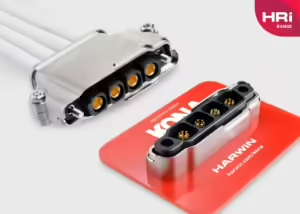
Enhancing Interconnect Reliability and Performance with Advanced Connector Backshells
In today’s advanced aerospace, defense, and medical applications, high-performance interconnects are critical for ensuring reliable, high-speed, and compact connections that can withstand extreme mechanical and electrical stresses. Connector backshells play a pivotal role in maintaining the mechanical and electrical integrity of these interconnects, offering robust protection against vibrations, shocks, and electromagnetic interference (EMI/RFI). This article delves into how modern backshell technologies safeguard interconnect performance and outlines key factors to consider during the specification phase.
The Importance of Connector Integrity
From satellites to MRI scanners, high-performance environments demand connectors that can endure harsh conditions, including extreme temperatures, vibration, shock, and EMI exposure. Failure in connector integrity can lead to malfunctions, signal degradation, or complete system failure. Therefore, understanding the operational environment is essential for ensuring long-term performance.
Consider the stark differences between an industrial robot and a cube satellite. An industrial robot faces continuous mechanical stress and contamination risks, while a cube satellite endures gravitational forces, extreme temperatures, and high radiation levels. Despite these variations, two fundamental requirements remain constant: mechanical resilience and electrical shielding.
Mechanical Integrity
Mechanical integrity ensures that connectors resist deformation, disconnection, or wear under physical stress. In environments with frequent vibrations or impacts, connectors must maintain stable, uninterrupted connections to prevent signal loss or component failure. Backshells provide critical strain relief by securing the cable-to-connector interface, mitigating movement that can cause fretting, wear, or disconnection. They also offer physical protection from external impacts, rough handling, and environmental hazards.
Without proper mechanical protection, cables are prone to damage from constant rubbing against chassis components, increasing the risk of exposed conductors and short circuits. In high-stakes environments, such as aerospace and defense, this protection is indispensable.

Electrical Integrity
Electrical performance is equally vital. Connectors must deliver consistent conductivity and shield signals from EMI/RFI to prevent signal degradation. Backshells enhance electrical integrity by offering comprehensive cable management and shielding solutions.
Proper backshell design minimizes electrical noise by tightly securing the cable braid to the enclosure, reducing interference from adjacent cables and preserving signal quality. Advanced backshells often feature 360° EMC shielding, creating a conductive barrier around the connector. This shielding blocks EMI from external sources and prevents internally generated noise from affecting surrounding systems. Additionally, effective grounding dissipates unwanted electrical noise, further maintaining signal clarity.
Material Selection for Backshells
Material choice significantly influences backshell performance. Backshells must withstand environmental conditions and mechanical stress while remaining lightweight and durable. Common materials include:
-
- Aluminum – Preferred for aerospace and military applications due to its high strength-to-weight ratio, excellent conductivity, and thermal dissipation properties.
-
- Stainless Steel – Provides superior strength and corrosion resistance but is heavier, making it less suitable for weight-sensitive applications.
-
- Composite Materials – Lightweight and corrosion-resistant, composites are used in applications where weight reduction is a priority.
Aluminum’s balance of strength, conductivity, and lightweight properties makes it the go-to choice for most high-performance applications.
Key Backshell Technologies
Modern backshells incorporate various technologies to meet the demands of complex environments:
-
- EMI/RFI Shielding – Backshells with integrated EMI shielding use conductive metal braids or barriers to minimize interference. This shielding must extend from the cable through to the PCB to ensure comprehensive protection.
-
- Angled Backshells – For space-constrained designs, angled backshells direct cables at 90°, reducing the clearance required behind the connector. They can also integrate EMI shielding, allowing for horizontal PCB-to-cable connections in compact environments.
-
- Two-Piece Construction – Some backshells feature modular designs that allow additional shielding or protection to be added late in the design process. This flexibility ensures adaptability to design changes without requiring PCB layout alterations.
 Application-Specific Considerations
Specifying the appropriate backshell involves evaluating the application’s mechanical and electrical demands. Whether designing for a robotic system, military drone, or medical device, the operational environment must guide material selection, shielding needs, and design flexibility.
Conclusion
Connector backshells are indispensable for ensuring the mechanical and electrical integrity of high-performance interconnects in demanding environments. By providing strain relief, vibration resistance, and comprehensive EMI shielding, backshells preserve the longevity and reliability of connectors in critical systems.
Early consideration of operational requirements, material selection, and potential design modifications will ensure optimal performance throughout the system’s lifecycle. In environments where precision and reliability are paramount, backshells serve as a critical safeguard, enhancing the overall resilience of interconnect systems.