
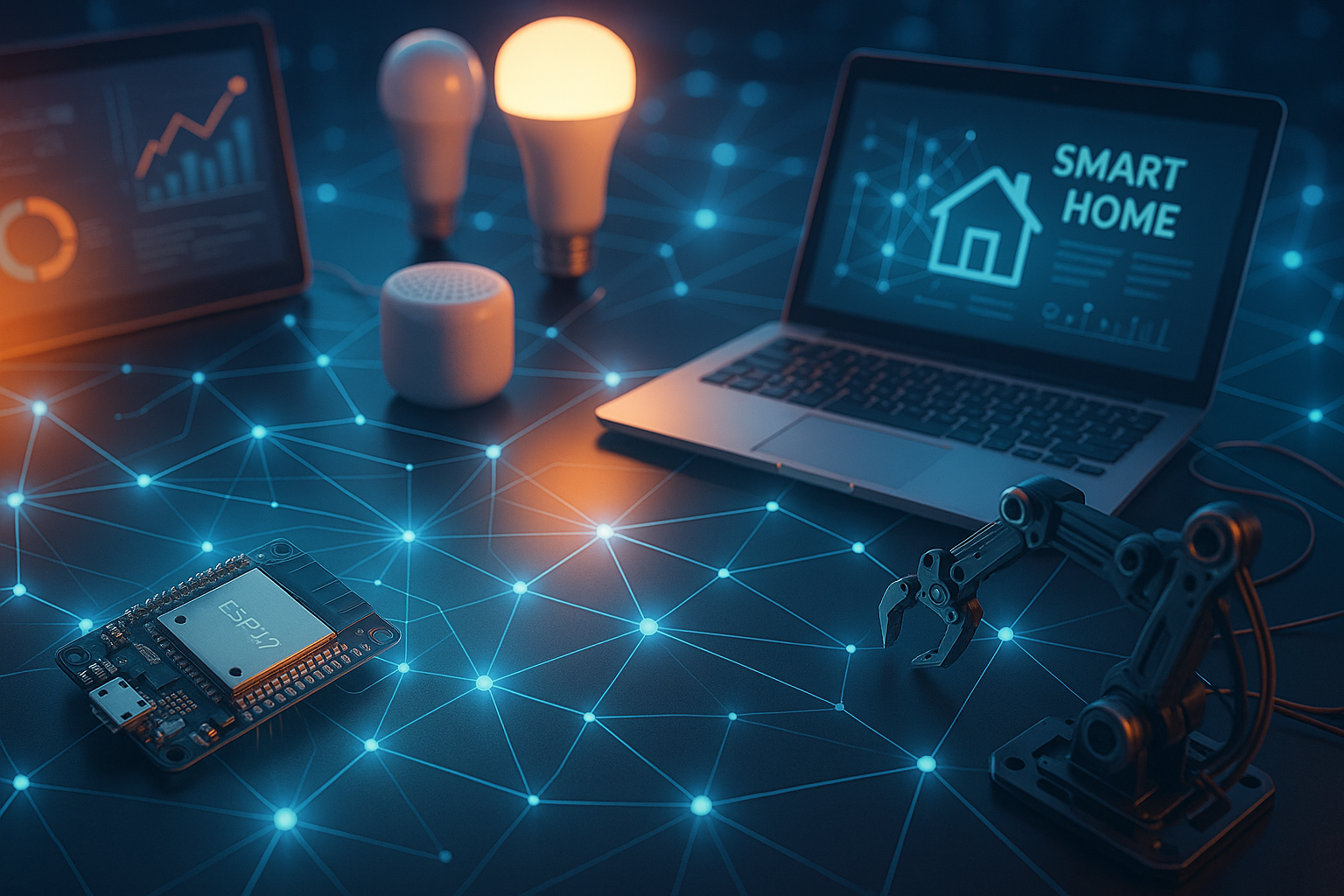

The ESP32 microcontroller continues to dominate the landscape of embedded systems and IoT development in 2025. Its low cost, integrated Wi-Fi and Bluetooth, and powerful dual-core processor make it an essential tool for engineers, students, and hobbyists. Whether you’re teaching microcontroller fundamentals or guiding learners through real-world automation projects, the ESP32 provides a robust platform for both foundational education and advanced experimentation. This guide highlights the most innovative and relevant ESP32 projects for this year, designed to inspire learners and practitioners in a technical academy setting.
Key ESP32 Project Categories in 2025
1. Smart Home & Automation
- Develop Wi-Fi/Bluetooth-enabled relays to control lighting systems, HVAC units, and household appliances.
- Integrate ESP32 with popular voice assistants such as Alexa and Google Assistant, and implement Matter protocol to ensure cross-platform compatibility.
- Build cloud-based dashboards and mobile apps using Arduino IoT Cloud, Blynk, or ESP RainMaker to enable seamless remote control and monitoring.
- Educate students on MQTT and REST APIs for robust data communication in smart home ecosystems.
2. IoT Monitoring & Environmental Sensing
- Construct water level indicators for overhead tanks and underground reservoirs using ultrasonic sensors and real-time alerts.
- Design and deploy automatic plant irrigation systems using soil moisture sensors and control algorithms.
- Implement weather monitoring stations capturing data on temperature, humidity, pressure, and air quality, with visualization via OLED displays and web dashboards.
- Teach students how to interface with DHT11/22, BMP180, and MQ135 sensors for practical environmental data collection.
3. Gesture & Voice Interaction
- Develop gesture-controlled LEDs and robots using MediaPipe, OpenCV, and Python on companion systems to interpret hand movements.
- Create interactive systems that respond to voice commands using Sinric Pro, allowing control of lights, fans, and security devices.
- Explore speech recognition techniques and natural language processing integrations with ESP32.
4. Advanced Wireless Communication
- Apply the ESP-NOW protocol for low-latency, peer-to-peer communication in home automation and sensor networks.
- Explore LoRa technology for setting up decentralized, long-range communication systems in agricultural and industrial applications.
- Demonstrate the practical advantages of low-power wide-area networks (LPWAN) using ESP32-based nodes.
5. Robotics & Creative Applications
- Program robotic arms and mobile platforms that respond to hand gestures or pre-defined paths using accelerometers and gyroscopes.
- Design fun and educational games like Ludo or Simon Says using ESP32 with LED matrices, buzzers, and tactile inputs.
- Teach real-time processing and multi-tasking by implementing state machines and non-blocking code structures in robotic applications.
Highlighted ESP32 Projects for 2025
| Project Title | Description |
|---|---|
| ESP32 Web-Based Home Automation | Control household devices through a responsive web interface; retain relay state using EEPROM during power failures |
| ESP32 + ESP-NOW Relay Control | Wireless switch system using OLED feedback; ideal for industrial automation or smart lighting control |
| Automated Plant Watering System | Utilize moisture sensor data to automate irrigation with real-time monitoring and manual override options |
| IoT Water Level Monitor | Monitor and visualize water tank status; send alerts via cloud services and display readings on OLED |
| Voice-Controlled WLED System | Integrate Alexa for voice control over LED strips with fallback IR remote and manual buttons |
| Matter-Enabled Multi-Relay Setup | Implement secure and interoperable multi-device control using the Matter standard for smart home networks |
| Gesture-Based Robot/LED Controller | Train students to build gesture-controlled systems using computer vision libraries and ESP32 communication protocols |
| Smart Weather Monitoring Station | Collect temperature, humidity, gas levels, and more; sync data to cloud and display locally |
| Parking Space & Distance Detector | Utilize ultrasonic sensors to create smart parking assistants with distance measurement and status notifications |
| ESP32 DIY Pedometer | Design a portable fitness tracker using the BMI160 IMU to count steps and display data on OLED screen |
Emerging Trends in ESP32 Development

- Matter Protocol Integration: The adoption of the Matter standard ensures interoperability and secure communication across devices from different manufacturers, setting a new benchmark for smart home development.
- No-Code/Low-Code Solutions: Platforms like ESP Zerocode allow users to generate firmware configurations without deep programming knowledge, making ESP32 accessible to non-CS majors and beginners.
- Hybrid Control Systems: Projects now often combine multiple communication technologies—Wi-Fi, Bluetooth, IR, and voice—for versatile user interfaces and fallback options.
- Cloud Ecosystem Expansion: With platforms like Blynk, ThingsBoard, and Firebase, students learn real-time data handling, analytics, and remote system management.
- Sustainable Tech Applications: Emphasis is placed on projects that promote energy efficiency, water conservation, and minimal environmental impact, fostering eco-conscious engineering.
Recommended Learning Resources for ESP32 Projects
- Random Nerd Tutorials: Offers an extensive library of over 250 ESP32 tutorials with practical schematics, source code, and setup instructions.
- Circuit Digest: Provides a steady stream of new project ideas with clearly explained wiring diagrams and code walkthroughs.
- IoT Circuit Hub: Focuses on home automation and ESP32-CAM use cases with in-depth implementation strategies.
- How2Electronics: Features over 100 projects including real-world applications like energy meters, weather stations, and security systems.
These resources equip technical academies with high-quality content for both structured coursework and self-directed exploration. They help bridge the gap between theoretical learning and hands-on application, preparing students for careers in embedded systems and IoT.