
Snagboot is a completely open source and vendor-tagnostic recovery and blincing tools Published by Bootlin in 2023. It consists of snagrecover And snagflashExecute the submarine on a target platform with the USB recovery mode and the non-fleeting storage devices with USB recovery mode with USB gadgets.
While the combination of snagrecover And snagflash Enables a board to regain during development. The requirements of the factory bubble are not fully addressed: fast processing of several boards in parallel, monitoring of individual board status during the flash process and compatibility with Windows, the most frequently used operation system on factory floors.
Already in March 2024, Texas instruments Contacted Bootlin with a project request: for growth Snagboot In an efficient tool with factory flash. The goal was for factory operators to have a way to flash groups of devices efficiently using a single user -friendly interface.
While this project could have been carried out internally at Texas Instruments, the Ti team recognized how important it is to consider this work agnostic and to promote this as an open source project. We thank Ti for the partnership with ourselves and for sponals of this tool, with which the needs of a variety of small and medium -sized manufacturing houses and industry generally do justice to.
As a result, Bootlin is proud to publish them 2.0 version of Snagbootincluding A Factory Blinking Tool, which is carried out on Windows and Linux!
This tool supports a wide range of platforms from different providers. All boards that use supported SoCs are supported even without additional efforts, provided that proper submarine support and USB recovery connections are forwarded to hardware.
For example the Ti AM62 And AM64 SOCs are fully supported by Snagboot. Therefore, all boards that use these platforms are Beagleplay Platform.
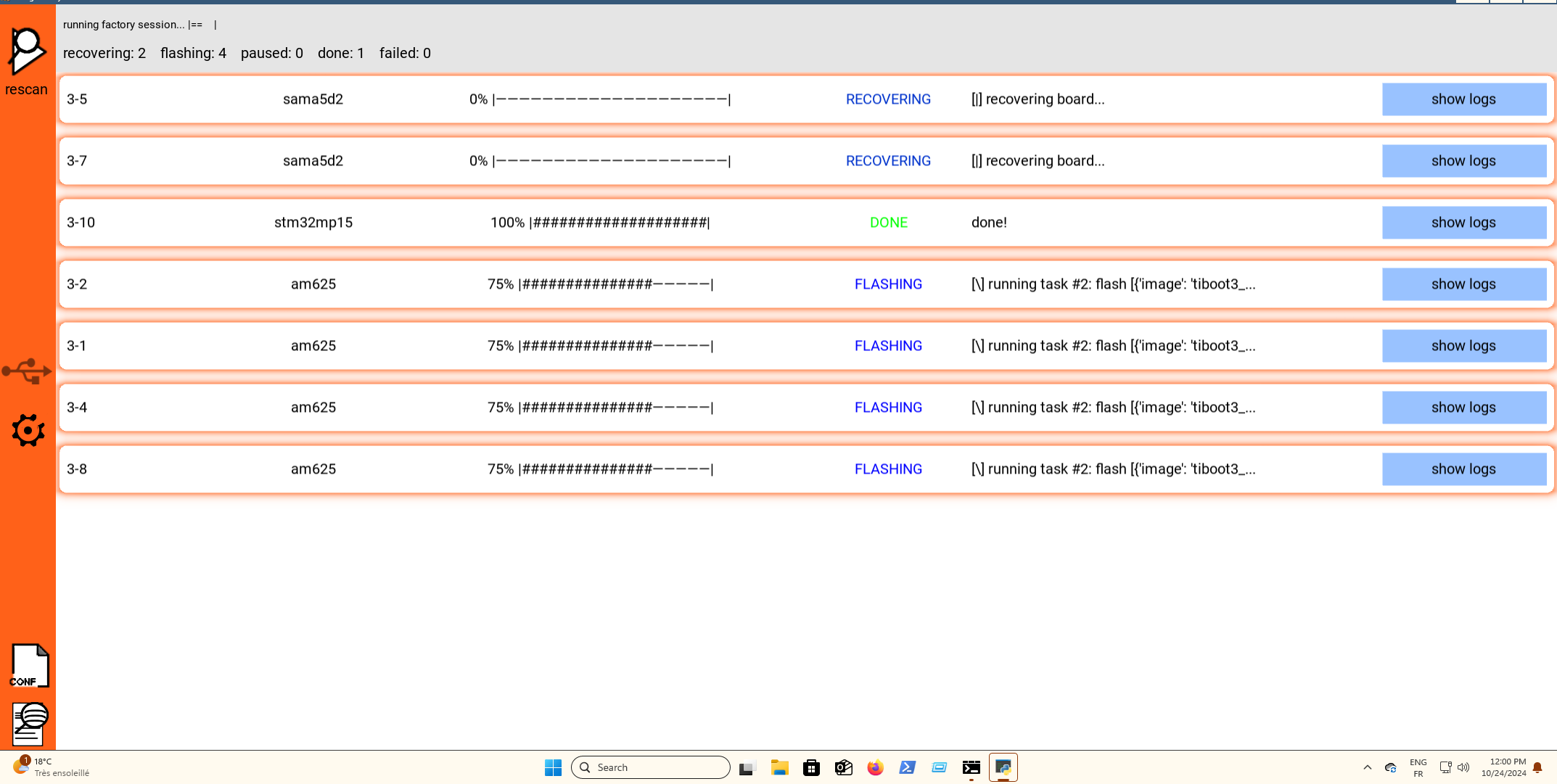
Groups of devices can be restored and flashed in parallel, and the flashing process can be monitored by a convenient GUI:
This tool is called Snagfactory. It is fully integrated into the snagboot package. The commands from Snagrover and Snagflash now also work as an additional bonus under Windows!
An efficient and standardized factory flash procedure is a valuable good for device manufacturers. This not only has an effect, it also increases reliability by eliminating the variability from the flink process.
A tool like Snagboot also offers better accountability by storing detailed logs of each individual factory flash process. This facilitates the examination of these operations and after the analysis according to the incident. Snagfactory configuration files are well suited for versioning.
In addition, the open source and vendor-tagnostic-nature of Snagfactory enable error loops and new functions to travel across corporate boundaries and thus companies that have decided to participate in its development to offer a competitive advantage.
The functions supported by Snagfactory include:
- Ordered pipelines from factory flash tasks.
- GPT partitioning.
- Huge image files flash (larger than the fastboat RAM buffer).
- Flashing BMAP -sparse pictures.
- EMMC hardware partitioning.
- Request for action of the operator in a certain step in the factory flash process.
- Saving factory flash results as detailed protocol files for accountability and troubleshooting.
Installation instructions are available Linux And Window In the Snagboot documentation, which also contains A User manual for Snagfactory.
With the configuration file format, users can design pipelines from flashing tasks and be used for each device.
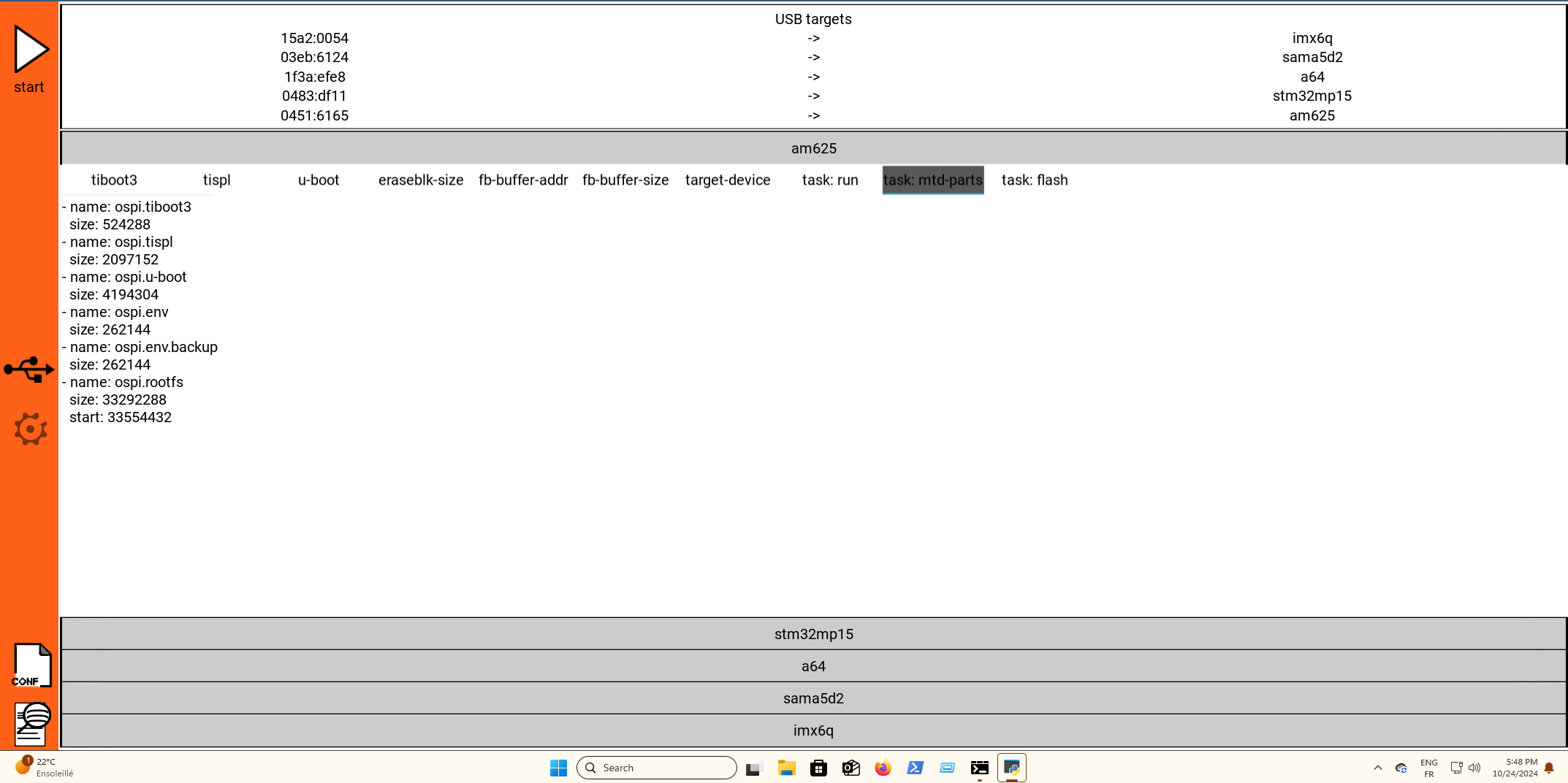 The following flashing tasks are currently supported:
- GPT: Write a GPT partition table on an EMMC or SD card
- Flash: Write a binary picture on a storage device or a partition. Supports the specification of an offset, flashes BMAP -SPARICAL FALLES and flashing huge images (larger than RAM buffer size).
- MTD parts: Write an MTD logical partition scheme in the submarine environment. This enables the targeting of MTD partitions with the name in the “Flash” command
- EMMC HW part: Burn an MMC hardware partition configuration; This is an irreversible operation; All -purpose partitions and Euda are supported
- Entry request: operator: Take the factory flash process for the card and ask the operator to fill out an action before resuming the pipeline
- reset: leads a soft reset on the finish and recovering the board
- run: leads a Fastboot command on the finish; Any submarine commands can also be carried out with OEM_RUN
Special thanks go to Texas Instruments to finance and support this great project! We plan to continue growing Snagfactory alongside the original snagboot tools. So don’t hesitate contribute If you are so inclined.