The ESP32-S31 is now in mass production. Espressif announced on 27 July 2026 that its new dual-core RISC-V AIoT SoC is on sale, and the community has since booted Linux on it. Here is how it compares with the ESP32-S3, ESP32-P4 and Raspberry Pi, and when to pick it.
What Espressif announced
According to Espressif’s mass-production announcement, the ESP32-S31 is aimed at smart home hubs, smart speakers, edge AI devices and industrial automation. The chip is available from Espressif’s official AliExpress store, and a dedicated ESP32-S31 developer portal hosts documentation, examples and tools.
The headline specs, as published by Espressif:
- CPU: dual-core 32-bit RISC-V up to 320 MHz; one core has a 128-bit data path and SIMD instructions. Espressif quotes 6.86 CoreMark/MHz.
- Low-power core: a 40 MHz RISC-V coprocessor.
- Memory: 512 KB on-chip SRAM, plus 250 MHz 8-bit DDR PSRAM expansion with simultaneous flash and PSRAM access.
- I/O: up to 60 GPIOs and up to 14 capacitive touch channels.
- Wireless: 2.4 GHz Wi-Fi 6, Bluetooth 5.4 (LE Audio plus Classic BR/EDR) and IEEE 802.15.4 for Thread and Zigbee, with Matter over Wi-Fi and Thread.
- Wired: a Gigabit (1000 Mbps) Ethernet MAC and USB 2.0 High-Speed OTG.
- Multimedia: DVP camera (8–16-bit), parallel LCD (8–24-bit RGB, I8080, MOTO6800), a JPEG codec, a Pixel-Processing Accelerator (PPA), 2D-DMA and dual I2S with hardware Bluetooth audio sync.
- Security: secure boot, flash and PSRAM encryption, AES/RSA/ECDSA/ECC accelerators, TRNG, RAM-based PUF, and TEE support.
Why the ESP32-S31 can boot Linux
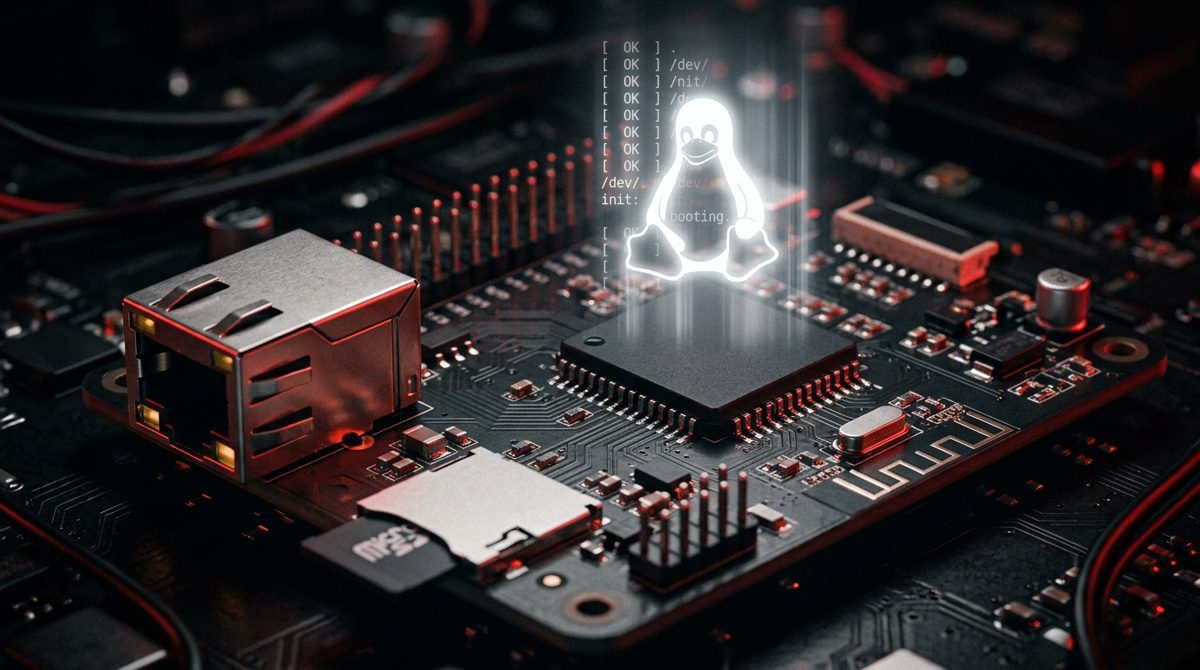
On earlier ESP32s, “MMU” meant a block that maps flash and PSRAM into the address space. As XDA Developers explains, the S31 is different: its datasheet describes Sv32 two-level page-table address translation and Machine, Supervisor and User privilege modes. That is the standard RISC-V setup a normal Linux kernel needs, with the kernel in S-mode and firmware such as OpenSBI underneath in M-mode.

XDA reports that Espressif published a Buildroot and U-Boot based Linux BSP in August, with a kernel, device tree and root file system, although Espressif says it is “not yet recommended for production use”. Community ports have moved quickly: one runs Linux 6.18, another, based on Linux 7.1, drives an 800×480 LCD console.
There are real limits. The chip has no DRAM controller. XDA notes that variants ship with 16 MB or 32 MB of in-package PSRAM, and the maximum is 64 MB, so the Linux builds run the kernel from flash to save RAM. There is no GPU or NPU. Treat Linux on the S31 as a learning platform for now, not a product base.
ESP32-S31 vs ESP32-S3 vs ESP32-P4 vs Raspberry Pi 5
Here is how each vendor’s published figures line up:
| Feature | ESP32-S31 | ESP32-S3 | ESP32-P4 | Raspberry Pi 5 |
|---|---|---|---|---|
| CPU | 2× RISC-V @ 320 MHz, SIMD on one core | 2× Xtensa LX7 @ 240 MHz, vector instructions | 2× RISC-V @ 400 MHz, FPU + AI extensions | 4× Arm Cortex-A76 @ 2.4 GHz |
| On-chip RAM | 512 KB SRAM + DDR PSRAM | 512 KB SRAM + PSRAM | 768 KB SRAM + PSRAM | 1–16 GB LPDDR4X |
| Wi-Fi / Bluetooth | Wi-Fi 6, BT 5.4 LE + Classic | Wi-Fi 4 (802.11 b/g/n), BT 5 LE | None (pair with a C/S-series chip) | Dual-band 802.11ac, BT 5.0 |
| Thread / Zigbee | Yes (802.15.4) | No | No | No |
| Ethernet | Gigabit MAC | No | Yes (100 Mbps per XDA) | Gigabit |
| Camera / display | DVP, parallel RGB LCD | Camera and LCD interfaces | MIPI-CSI with ISP, MIPI-DSI, H.264 1080p30 | 2× MIPI, dual 4Kp60 HDMI |
| GPIOs | Up to 60 | 45 | 55 | 40-pin header |
| Linux | Early BSP and community ports | No | No | Full Raspberry Pi OS |
Sources: ESP32-S31 product page, Espressif’s ESP32-S3 and ESP32-P4 pages, and the Raspberry Pi 5 specification page. Espressif’s Jeroen Domburg, quoted by XDA, said the S31 core is derived from the P4’s and puts it at nearly twice the speed of the S3.
Edge AI on the ESP32-S31: what to expect
Espressif positions the S31 for neural network inference, signal processing, computer vision and intelligent audio. The SIMD-capable 128-bit core is where that work happens, much like the vector instructions on the S3 that ESP-NN and ESP-DL use today.
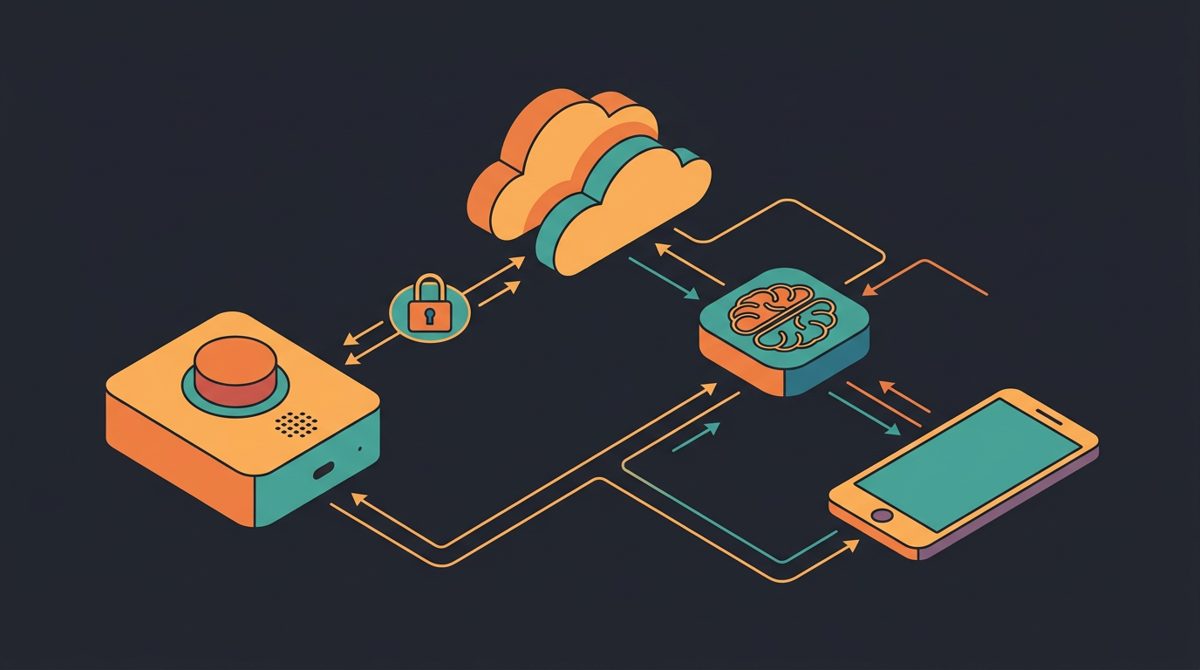
Set your expectations for MCU-class AI: keyword spotting, small CNNs for person or object detection on low-resolution frames, anomaly detection on sensor data, and audio classification. The S31 is a well-connected AI client, not an AI server. Espressif also says it will work with its ESP Private Agents platform and common LLMs, which means the device handles the voice, the radios and the UI while the large model runs in the cloud. If you need on-device LLMs or heavy vision, a Raspberry Pi is still the right tool. For the bigger picture, see why edge AI on microcontrollers is getting serious.
When to pick the ESP32-S31, and when not to
Pick the ESP32-S31 when
- You are building a Matter or Thread border router, a Zigbee coordinator or a smart home hub that also needs Wi-Fi 6 and wired Ethernet, all on one chip.
- You need a gateway with Gigabit Ethernet and microcontroller-class power draw. XDA cites about 91 mA with both cores in modem-sleep at 320 MHz and peripheral clocks off.
- Your product is an LE Audio or Bluetooth Classic speaker, an intercom, or a video doorbell with a DVP camera.
- You want touch HMI plus wireless without adding a separate radio chip.
Choose something else when
- ESP32-S3: you need a mature, well-documented part today with stable ESP-IDF releases, Arduino libraries and cheap modules, and Wi-Fi 4 is enough.
- ESP32-P4: you need MIPI-CSI/DSI, an ISP, H.264 encoding or 1080p displays. Pair it with a wireless companion chip.
- Raspberry Pi: you need a real Linux userspace, gigabytes of RAM, Python/OpenCV workloads, a desktop, or containers. Our guide to Raspberry Pi vs mini PC vs microcontroller walks through that decision.
What this means for embedded engineers
A practical way to start:
- Set up the right ESP-IDF. The developer portal says the S31 is currently supported only on the ESP-IDF master branch (v6.1 and later). Use the ESP-IDF Installation Manager (EIM) or a separate checkout so it does not break your stable projects, then run
idf.py set-target esp32s31. - Start from a dev board. Espressif lists the ESP32-S31-Function-CoreBoard-1, the ESP32-S31-Korvo-1 multimedia board and the ESP-Mosaico interaction board. Move to modules (such as the WROOM-1 and WROOM-3 families) when you go to production, since they carry RF certification.
- Plan memory early. Decide what lives in the 512 KB of SRAM and what lives in PSRAM. Put DMA buffers, ISR data and hot inference tensors in internal RAM, and frame buffers and model weights in PSRAM.
- Learn the SIMD path. Profile a small model with ESP-DL or ESP-NN and compare the scalar and SIMD kernels. Quantise to int8 before you optimise anything else.
- Treat the datasheet as preliminary. XDA points out that the datasheet is still v0.5 and lists an 80 MHz PSRAM clock, which conflicts with Espressif’s published 250 MHz. Check pin multiplexing against the latest docs before you lay out a PCB. Our guide to building custom ESP32 boards covers the layout basics.
- Experiment with Linux safely. Flash the Espressif BSP or a community port on a spare board to learn device trees, U-Boot and RISC-V privilege modes. Keep FreeRTOS on ESP-IDF for anything you ship.
Key takeaways
- The ESP32-S31 entered mass production on 27 July 2026 and is on sale now.
- It combines Wi-Fi 6, Bluetooth 5.4 (LE and Classic), Thread/Zigbee, Gigabit Ethernet and USB 2.0 HS on a 320 MHz dual-core RISC-V.
- A real Sv32 MMU and M/S/U privilege modes make Linux possible, but RAM is capped at 64 MB of PSRAM and the BSP is not production-ready.
- It is the best ESP32 for connected hubs, gateways and audio. The P4 is still the pick for MIPI video, and a Raspberry Pi for full Linux and heavy AI.
FAQ
Is the ESP32-S31 a replacement for the ESP32-S3?
Not directly. Despite the name, it uses RISC-V cores instead of the S3’s Xtensa LX7, so it is a new design. It is faster and far better connected, but the S3 has a much more mature software ecosystem today.
Can the ESP32-S31 replace a Raspberry Pi?
For most Linux projects, no. It can boot a Linux console, but it has at most 64 MB of PSRAM, no GPU and only early Linux support. It replaces a Pi only where the Pi was mainly a network or wireless bridge.
Which framework supports the ESP32-S31?
ESP-IDF, currently on the master branch (v6.1 and later), plus ESP-Matter, ESP-GMF, ESP-BLE-MESH and ESP-BLE-AUDIO. It can also act as a connectivity coprocessor through ESP-Hosted and ESP-AT.
Does the ESP32-S31 have an NPU for AI?
No. AI acceleration comes from a 128-bit SIMD data path on one CPU core, plus the JPEG codec and PPA for image pre-processing.
Want to master ESP32, embedded AI and IoT design hands-on? Explore the Educational Engineering Team courses at https://eduengteam.com/wp-content/uploads/2026/10/meta-muse-gadgets-esp32-ai-agent-diagram.jpg.