
Why Most Digital Business Cards Are Forgettable—and How AR Fixes It
A009-featured.webp
This guide approaches “Why Most Digital Business Cards Are Forgettable—and How AR Fixes It” as a practical, testable problem rather than a collection of disconnected tips. The objective is to turn the topic into measurable decisions, with particular attention to NFC, QR codes, and AR scenes. You will get an organized analysis method, an implementation sequence, realistic failure tests, and a readiness checklist that moves the result beyond a one-time demonstration.
How the problem shows up
One successful run does not establish reliability; repeat the scenario with different inputs and operating conditions and look for reproducible behavior. Use a small controlled reproduction before scaling up because compact test cases make state, timing, and interface mistakes easier to observe. Use phone testing to collect direct evidence and record load time before the change so the comparison has a trustworthy baseline. One successful run does not establish reliability; repeat the scenario with different inputs and operating conditions and look for reproducible behavior. Use a small controlled reproduction before scaling up because compact test cases make state, timing, and interface mistakes easier to observe.
Prefer comparable measurements such as conversion over screenshots or one-off demonstrations that cannot be reproduced later. Apply small assets during each iteration so every observed improvement or regression can be connected to a specific change. Record the hypothesis, the test, and the result in a short experiment log; this prevents circular troubleshooting and makes later maintenance much faster. Prefer comparable measurements such as conversion over screenshots or one-off demonstrations that cannot be reproduced later. Apply small assets during each iteration so every observed improvement or regression can be connected to a specific change.
Likely root causes
Divide the solution into layers with explicit inputs, outputs, assumptions, and success criteria, then trace the symptom back to the first layer that violates its contract. Separate functional correctness from reliability: first prove that the intended behavior is correct, then prove that it remains correct under realistic load and fault conditions. In AR & Digital Business Cards, AR scenes, mobile browsers, and 3D assets often interact, so inspecting only one layer can hide the actual cause. Divide the solution into layers with explicit inputs, outputs, assumptions, and success criteria, then trace the symptom back to the first layer that violates its contract.
Start by converting the article's main outcome into a clear success criterion that can be measured before the system is changed. Exercise resets, disconnects, invalid input, noisy conditions, and resource limits while watching conversion instead of relying on appearance alone. Review boundaries between components carefully because mismatched units, timing, electrical levels, data formats, and ownership rules frequently create symptoms that appear random. Start by converting the article's main outcome into a clear success criterion that can be measured before the system is changed. Exercise resets, disconnects, invalid input, noisy conditions, and resource limits while watching conversion instead of relying on appearance alone.
A diagnostic order that saves time
One successful run does not establish reliability; repeat the scenario with different inputs and operating conditions and look for reproducible behavior. Use a small controlled reproduction before scaling up because compact test cases make state, timing, and interface mistakes easier to observe. Use browser dev tools to collect direct evidence and record conversion before the change so the comparison has a trustworthy baseline. One successful run does not establish reliability; repeat the scenario with different inputs and operating conditions and look for reproducible behavior. Use a small controlled reproduction before scaling up because compact test cases make state, timing, and interface mistakes easier to observe.
Separate functional correctness from reliability: first prove that the intended behavior is correct, then prove that it remains correct under realistic load and fault conditions. In AR & Digital Business Cards, landing pages, analytics, and fallback paths often interact, so inspecting only one layer can hide the actual cause. Divide the solution into layers with explicit inputs, outputs, assumptions, and success criteria, then trace the symptom back to the first layer that violates its contract. Separate functional correctness from reliability: first prove that the intended behavior is correct, then prove that it remains correct under realistic load and fault conditions.
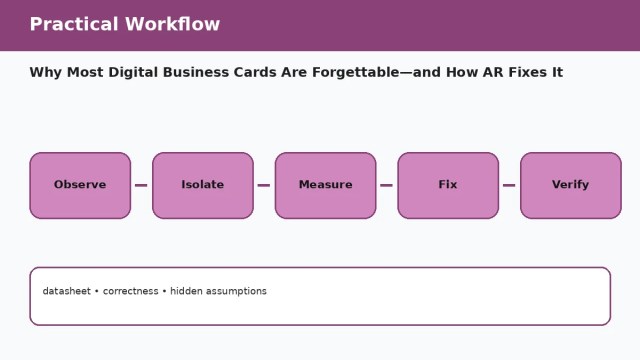
What to measure instead of guessing
Deliberately test for slow loading; a failure condition that is never exercised during testing is likely to surface later under less controlled conditions. If engagement becomes worse after a modification, return to the last known-good version and compare measurements before introducing another change. Treat generated code, vendor libraries, and convenience tools as components to verify rather than as proof that the overall design is correct. Deliberately test for slow loading; a failure condition that is never exercised during testing is likely to surface later under less controlled conditions.
Divide the solution into layers with explicit inputs, outputs, assumptions, and success criteria, then trace the symptom back to the first layer that violates its contract. Separate functional correctness from reliability: first prove that the intended behavior is correct, then prove that it remains correct under realistic load and fault conditions. In AR & Digital Business Cards, fallback paths, NFC, and QR codes often interact, so inspecting only one layer can hide the actual cause. Divide the solution into layers with explicit inputs, outputs, assumptions, and success criteria, then trace the symptom back to the first layer that violates its contract.
| Area | What to check | Useful measure |
|---|---|---|
| NFC | Interaction with QR codes | load time |
| AR scenes | Impact of slow loading | scan rate |
| Reliability | Restart and realistic fault behavior | engagement |
| Maintainability | Documentation and reproducibility | bounce rate |
Fixes that address the cause
Deliberately test for broken permissions; a failure condition that is never exercised during testing is likely to surface later under less controlled conditions. If conversion becomes worse after a modification, return to the last known-good version and compare measurements before introducing another change. Treat generated code, vendor libraries, and convenience tools as components to verify rather than as proof that the overall design is correct. Deliberately test for broken permissions; a failure condition that is never exercised during testing is likely to surface later under less controlled conditions.
Treat generated code, vendor libraries, and convenience tools as components to verify rather than as proof that the overall design is correct. Deliberately test for oversized 3D assets; a failure condition that is never exercised during testing is likely to surface later under less controlled conditions. If repeat visits becomes worse after a modification, return to the last known-good version and compare measurements before introducing another change. Treat generated code, vendor libraries, and convenience tools as components to verify rather than as proof that the overall design is correct.
- Use phone testing to verify load time.
- Use web analytics to verify scan rate.
- Use QR/NFC tools to verify engagement.
- Use 3D viewer to verify bounce rate.
- Use browser dev tools to verify conversion.
How to stop the problem returning
Exercise resets, disconnects, invalid input, noisy conditions, and resource limits while watching repeat visits instead of relying on appearance alone. Review boundaries between components carefully because mismatched units, timing, electrical levels, data formats, and ownership rules frequently create symptoms that appear random. Start by converting the article's main outcome into a clear success criterion that can be measured before the system is changed. Exercise resets, disconnects, invalid input, noisy conditions, and resource limits while watching repeat visits instead of relying on appearance alone. Review boundaries between components carefully because mismatched units, timing, electrical levels, data formats, and ownership rules frequently create symptoms that appear random.
Deliberately test for device incompatibility; a failure condition that is never exercised during testing is likely to surface later under less controlled conditions. If scan rate becomes worse after a modification, return to the last known-good version and compare measurements before introducing another change. Treat generated code, vendor libraries, and convenience tools as components to verify rather than as proof that the overall design is correct. Deliberately test for device incompatibility; a failure condition that is never exercised during testing is likely to surface later under less controlled conditions.
How to validate the final result
Divide the solution into layers with explicit inputs, outputs, assumptions, and success criteria, then trace the symptom back to the first layer that violates its contract. Separate functional correctness from reliability: first prove that the intended behavior is correct, then prove that it remains correct under realistic load and fault conditions. In AR & Digital Business Cards, 3D assets, landing pages, and analytics often interact, so inspecting only one layer can hide the actual cause. Divide the solution into layers with explicit inputs, outputs, assumptions, and success criteria, then trace the symptom back to the first layer that violates its contract.
Apply small assets during each iteration so every observed improvement or regression can be connected to a specific change. Record the hypothesis, the test, and the result in a short experiment log; this prevents circular troubleshooting and makes later maintenance much faster. Prefer comparable measurements such as conversion over screenshots or one-off demonstrations that cannot be reproduced later. Apply small assets during each iteration so every observed improvement or regression can be connected to a specific change. Record the hypothesis, the test, and the result in a short experiment log; this prevents circular troubleshooting and makes later maintenance much faster.
Frequently asked questions
What should I measure first?
In AR & Digital Business Cards, analytics, fallback paths, and NFC often interact, so inspecting only one layer can hide the actual cause. Divide the solution into layers with explicit inputs, outputs, assumptions, and success criteria, then trace the symptom back to the first layer that violates its contract. Separate functional correctness from reliability: first prove that the intended behavior is correct, then prove that it remains correct under realistic load and fault conditions.
How do I know the solution is robust?
One successful run does not establish reliability; repeat the scenario with different inputs and operating conditions and look for reproducible behavior. Use a small controlled reproduction before scaling up because compact test cases make state, timing, and interface mistakes easier to observe. Use web analytics to collect direct evidence and record scan rate before the change so the comparison has a trustworthy baseline. One successful run does not establish reliability; repeat the scenario with different inputs and operating conditions and look for reproducible behavior.
Which tool gives the fastest useful evidence?
Record the hypothesis, the test, and the result in a short experiment log; this prevents circular troubleshooting and makes later maintenance much faster. Prefer comparable measurements such as repeat visits over screenshots or one-off demonstrations that cannot be reproduced later. Apply clear fallback during each iteration so every observed improvement or regression can be connected to a specific change. Record the hypothesis, the test, and the result in a short experiment log; this prevents circular troubleshooting and makes later maintenance much faster.
When should I redesign instead of continuing to debug?
Start by converting the article's main outcome into a clear success criterion that can be measured before the system is changed. Exercise resets, disconnects, invalid input, noisy conditions, and resource limits while watching conversion instead of relying on appearance alone. Review boundaries between components carefully because mismatched units, timing, electrical levels, data formats, and ownership rules frequently create symptoms that appear random. Start by converting the article's main outcome into a clear success criterion that can be measured before the system is changed.
Final readiness checklist
- Define the success criterion before changing any setting.
- Review NFC and QR codes and write down the assumptions behind them.
- Use phone testing to capture a baseline measurement.
- Deliberately test for slow loading in a controlled way.
- Record load time and scan rate before and after the change.
- Test a restart and at least one realistic fault condition.
- Document the final version and the evidence that makes the result trustworthy.
Advanced practical field notes
Start by converting the article's main outcome into a clear success criterion that can be measured before the system is changed. Exercise resets, disconnects, invalid input, noisy conditions, and resource limits while watching repeat visits instead of relying on appearance alone. Review boundaries between components carefully because mismatched units, timing, electrical levels, data formats, and ownership rules frequently create symptoms that appear random. Start by converting the article's main outcome into a clear success criterion that can be measured before the system is changed.
Deliberately test for device incompatibility; a failure condition that is never exercised during testing is likely to surface later under less controlled conditions. If scan rate becomes worse after a modification, return to the last known-good version and compare measurements before introducing another change. Treat generated code, vendor libraries, and convenience tools as components to verify rather than as proof that the overall design is correct. Deliberately test for device incompatibility; a failure condition that is never exercised during testing is likely to surface later under less controlled conditions.
Exercise resets, disconnects, invalid input, noisy conditions, and resource limits while watching scan rate instead of relying on appearance alone. Review boundaries between components carefully because mismatched units, timing, electrical levels, data formats, and ownership rules frequently create symptoms that appear random. Start by converting the article's main outcome into a clear success criterion that can be measured before the system is changed. Exercise resets, disconnects, invalid input, noisy conditions, and resource limits while watching scan rate instead of relying on appearance alone.
Use web analytics to collect direct evidence and record scan rate before the change so the comparison has a trustworthy baseline. One successful run does not establish reliability; repeat the scenario with different inputs and operating conditions and look for reproducible behavior. Use a small controlled reproduction before scaling up because compact test cases make state, timing, and interface mistakes easier to observe. Use web analytics to collect direct evidence and record scan rate before the change so the comparison has a trustworthy baseline.
Document why the chosen solution works, not only the steps used to reach it. Document why the chosen solution works, not only the steps used to reach it. Document why the chosen solution works, not only the steps used to reach it. Retest after a restart because stable recovery is part of a reliable design.
Conclusion
Apply clear fallback during each iteration so every observed improvement or regression can be connected to a specific change. Record the hypothesis, the test, and the result in a short experiment log; this prevents circular troubleshooting and makes later maintenance much faster. Prefer comparable measurements such as repeat visits over screenshots or one-off demonstrations that cannot be reproduced later. Apply clear fallback during each iteration so every observed improvement or regression can be connected to a specific change. Record the hypothesis, the test, and the result in a short experiment log; this prevents circular troubleshooting and makes later maintenance much faster. Prefer comparable measurements such as repeat visits over screenshots or one-off demonstrations that cannot be reproduced later.