
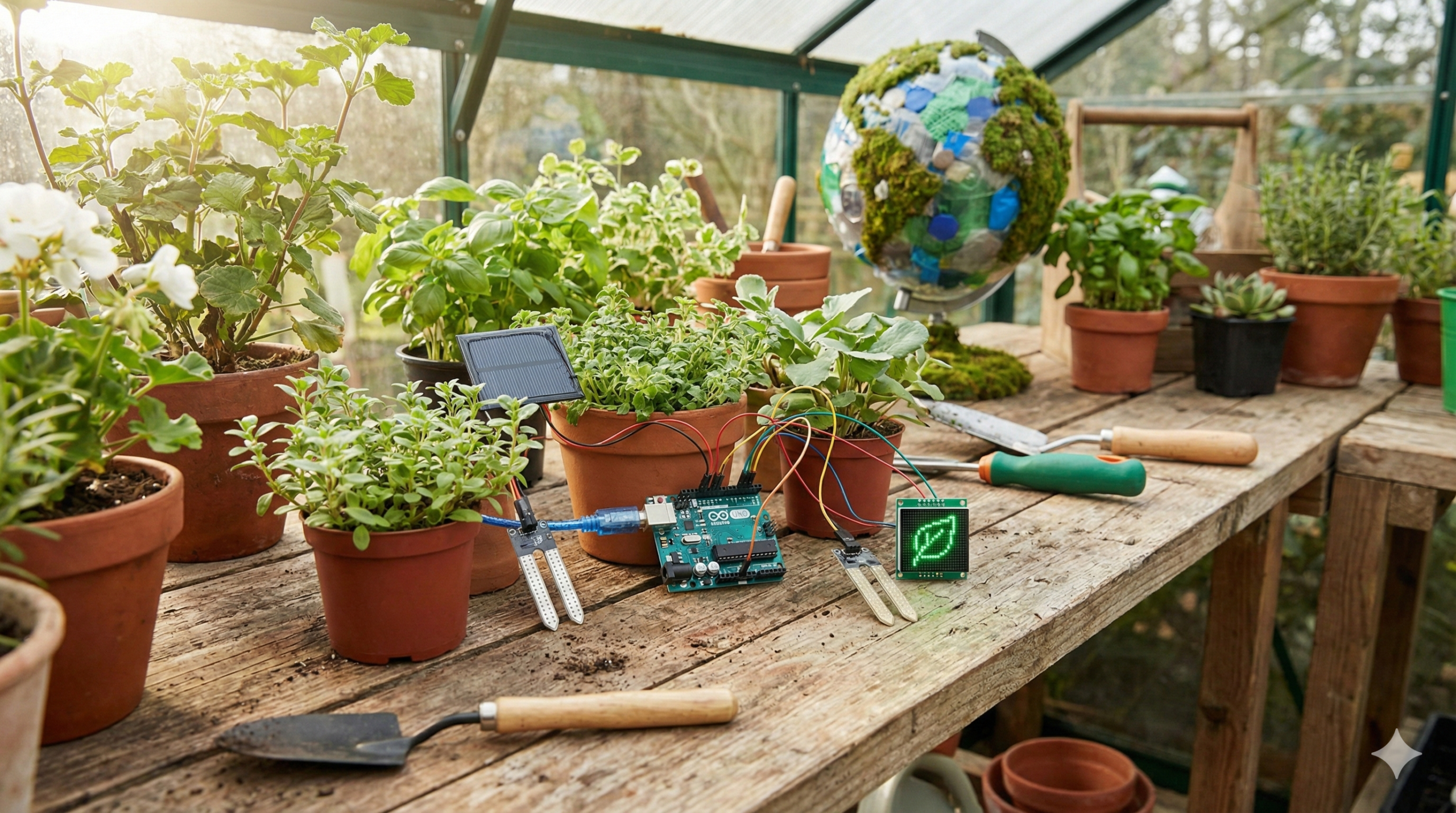
Green technology is no longer a futuristic concept reserved for large corporations or government initiatives. It is rapidly becoming a grassroots movement driven by innovators, educators, and increasingly — students. At the heart of this transformation sits a deceptively simple tool: the Arduino.
Arduino and ESP32 boards have democratized environmental innovation. What once required expensive industrial equipment can now be achieved with a microcontroller that costs less than a textbook. Pair a board with a few sensors, and suddenly you have a system capable of monitoring water usage, tracking pollution, reducing energy waste, and even growing food sustainably.

This accessibility is precisely why Arduino has become a cornerstone of modern STEM education. Students aren’t just learning theory — they are building real systems that generate data, trigger automation, and create measurable environmental impact.
Even more compelling is the feedback loop these projects provide. Data appears instantly on screens. Alerts reach phones in seconds. Waste reduction becomes visible within days. That immediacy transforms abstract sustainability concepts into tangible engineering achievements.
Why Arduino is Ideal for Green Technology
Before diving into the projects, it is important to understand why Arduino is uniquely suited for sustainability applications.
1. Ultra-Low Barrier to Entry
Arduino boards are inexpensive, widely available, and supported by massive global communities. Tutorials, open-source libraries, and example code eliminate the traditional friction of hardware development.
2. Energy Efficient by Design
Microcontrollers consume minimal power compared to full computing systems. Many environmental monitors run continuously for months using small batteries or solar panels.
3. Sensor Compatibility
Arduino supports thousands of sensors — from air quality modules to soil moisture probes — making it the perfect bridge between the physical world and digital intelligence.
4. Rapid Prototyping
Students can assemble working systems in hours rather than weeks. This speed encourages experimentation and iteration — essential habits for future engineers.
5. Real-World Deployment
Unlike classroom simulations, these devices operate in real environments. They measure actual water levels, detect real pollution, and reduce genuine waste.
The result is a learning experience that feels less like homework and more like engineering leadership.
1. Water Tank Level Monitor
The Problem: Silent Water Waste
Across homes and schools worldwide, water tanks overflow daily due to simple human oversight. A forgotten pump or unnoticed fill cycle can waste hundreds of liters in hours.
Multiply that across months, and the environmental cost becomes staggering.
The Solution
An Arduino paired with an ultrasonic sensor such as the HC-SR04 can continuously measure the distance between the sensor and the water surface.
As the level rises, the system updates LED indicators:
- Green → Tank is low
- Yellow → Medium level
- Red → Nearly full
- Buzzer → Overflow warning
Upgrade to an ESP32, and the system can send alerts directly to a smartphone using platforms like Blynk.
Environmental Impact
A typical household can waste thousands of liters annually from unnoticed overflows. Automated monitoring eliminates that loss entirely.
Engineering Skills Learned
- Distance measurement using sound waves
- Analog vs digital sensor logic
- Threshold-based automation
- Alert system design
Student Appeal
Watching a tank fill in real time transforms water conservation from a lecture into an engineering triumph.
2. Air Quality Tracker
The Problem: Invisible Pollution
Indoor air can be significantly more polluted than outdoor air — especially in classrooms, dormitories, and labs.
Dust, smoke, and carbon compounds accumulate silently, impacting focus, health, and long-term wellbeing.
The Solution
Using sensors like MQ-135 or PMS5003, Arduino can measure:
- CO₂ concentration
- Harmful gases
- PM2.5 particles
An OLED screen displays a color-coded Air Quality Index:
- Green → Safe
- Yellow → Moderate
- Red → Hazardous
With ESP32 integration, data uploads to cloud platforms such as ThingSpeak, allowing long-term environmental analysis.
Environmental Impact
Awareness drives behavior change. Once students see pollution spikes, they open windows, add plants, improve airflow, and reduce emission sources.
Skills Developed
- Environmental data logging
- Cloud dashboards
- Data visualization
- Calibration techniques
Student Appeal
Few things are more motivating than proving — with data — that your classroom needs cleaner air.
3. Solar-Powered Plant Watering System

The Problem: Forgotten Plants and Wasted Energy
Urban living has sparked renewed interest in small-scale food production — herbs on windowsills, vegetables on balconies. Yet plants often die due to inconsistent watering.
Manual pumps also draw unnecessary grid power.
The Solution
Combine:
- Soil moisture sensor
- Mini water pump
- Solar panel
- Arduino or ESP32
When soil moisture drops below a threshold, the pump activates automatically — powered entirely by sunlight.
An LCD displays moisture levels, helping students understand plant health.
Environmental Impact
- Encourages local food growth
- Reduces transportation emissions (“food miles”)
- Eliminates grid electricity usage
Skills Learned
- Renewable energy integration
- Power management
- Closed-loop automation
- Agricultural IoT concepts
Student Appeal
A self-watering garden feels like engineering magic — and tastes even better.
4. Smart Waste Bin Alert
The Problem: Overflowing Bins
School campuses frequently struggle with waste management. Overflowing bins lead to litter, pests, and increased landfill contributions.
The Solution
Mount an ultrasonic sensor inside the bin lid. When trash reaches a predefined level:
- LED changes color
- Buzzer alerts staff
- ESP32 sends a notification
Maintenance teams empty bins only when needed — optimizing pickup routes.
Environmental Impact
Studies show smart waste systems can reduce collection trips by up to 50%, lowering fuel consumption and emissions.
Skills Developed
- Smart infrastructure design
- IoT notifications
- Efficiency modeling
Student Appeal
Turning a trash bin into an intelligent system is unexpectedly satisfying — and visibly impactful.
5. Energy-Saving Light Controller

The Problem: Lights Burning in Empty Rooms
Energy waste is one of the easiest environmental problems to fix — yet it persists everywhere.
The Solution
A PIR motion sensor detects presence while an LDR measures ambient light.
If a room is empty or naturally bright, Arduino switches lights off via relay.
ESP32 adds scheduling and remote overrides.
Environmental Impact
Smart lighting can reduce electricity consumption by up to 30% in high-traffic buildings.
Skills Learned
- Sensor fusion
- Relay control
- Behavioral automation
Student Appeal
Lights that “know” when you leave feel futuristic — and slash power bills.
6. Rainwater Harvesting Monitor
The Problem: Wasted Rainfall
Many buildings install rain barrels but rely on guesswork to manage them.
Overflow means lost opportunity.
The Solution
Install:
- Water level sensor
- Rain gauge
- Arduino controller
The system tracks collected water and alerts users before overflow.
ESP32 can even combine weather forecasts to predict incoming rain.
Environmental Impact
Maximizing rainwater reduces reliance on treated municipal supplies — saving energy used in water processing.
Skills Developed
- Predictive environmental systems
- Sensor networks
- Data-driven conservation
Student Appeal
Turning rooftops into water factories reframes sustainability as innovation.
7. Compost Moisture and Temperature Tracker

The Problem: Failed Compost
Effective composting requires precise moisture and temperature ranges. Too dry or too wet, and decomposition stalls.
The Solution
Using a DHT22 sensor plus soil probe, Arduino monitors compost conditions and logs data locally or to the cloud.
Alerts guide users toward the ideal 40–60% moisture range.
Environmental Impact
Proper composting reduces methane emissions from landfills and enriches soil naturally.
Skills Learned
- Biological system monitoring
- Data logging
- Environmental analytics
Student Appeal
Data-driven compost turns waste into engineered fertility.
Project Snapshot
| Project | Key Sensor | Cost | Waste Reduced | Difficulty |
|---|---|---|---|---|
| Water Tank | Ultrasonic | $8 | Water (~50%) | Beginner |
| Air Quality | MQ-135 | $10 | Pollution | Beginner |
| Plant Watering | Moisture | $12 | Food transport | Easy |
| Waste Bin | Ultrasonic | $7 | Landfill (~30%) | Beginner |
| Light Control | PIR/LDR | $9 | Energy (~30%) | Easy |
| Rainwater | Level | $11 | Water waste | Medium |
| Compost | DHT22 | $13 | Methane | Medium |
The Bigger Picture: Engineers as Environmental Architects
The engineers of the next decade will not be judged solely by performance metrics or computational efficiency. They will be measured by their ability to design systems that respect planetary boundaries.
Arduino gives students that opportunity early.
Each automated light reduces emissions.
Each monitored tank saves water.
Each compost tracker diverts waste from landfills.
Small devices — massive ripple effects.
Green technology is no longer a distant frontier.
It is sitting on a breadboard, waiting for power.
And the next breakthrough might come not from a research lab, but from a student who decided to build something that matters.